

Running on Empty
On lessons learned from three decades spent jogging

[Note: I stand in solidarity with today’s nationwide economic blackout. I will buy nothing, and I will support all businesses that join the general strike. The following post is an expanded and revised excerpt from my 2025 TIC CON Keynote address for the Tourette’s Association of America.]
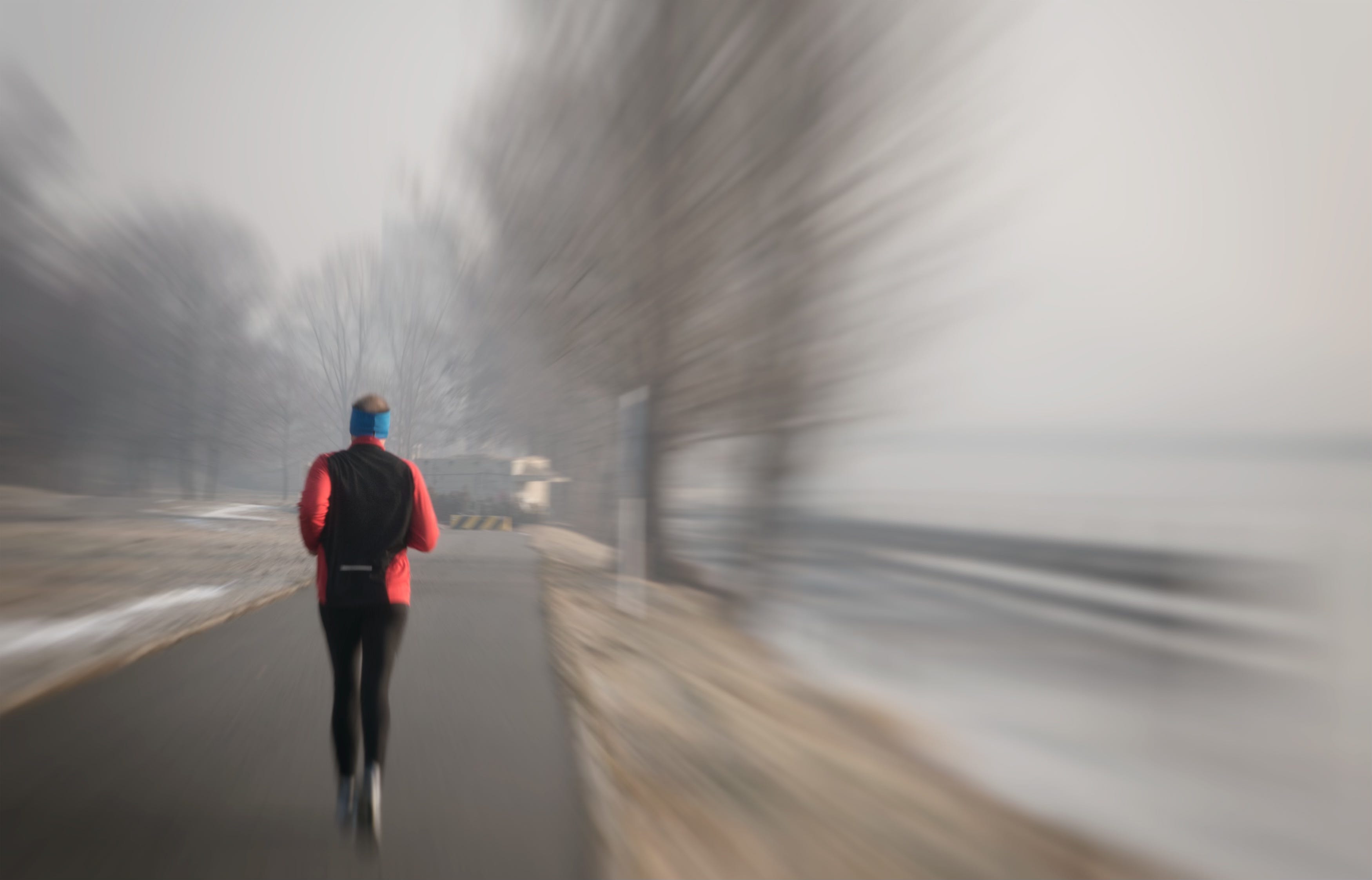
When I was in high school, I learned a trick to help me avoid people and improve my physical health. I cinched up my sneaks and sprinted up and down the road late at night. I continued doing this for many years, and eventually it morphed into a serious passion for running.
As a teenager, I hated being cooped up inside, especially on the long, dark nights of winter in Western New York. I couldn’t watch television, couldn’t sit still to read a book, I didn’t want to talk to anyone, and my mind (like any teenager’s mind) was a 500,000,000 piece jigsaw puzzle of thoughts and anxieties and doubts.
This Substack is subtitled “A Tourette’s Life,” but as regular readers know, I don’t always write about Tourette’s. But I am today, sort of. There are differing theories as to why people develop TS, and I don’t pretend to know the answer. What I do know is that I’ve been observing myself (and my tics) since I was a kid, and I think I’ve got a pretty good idea of why I do what I do. As a child, to cope with my copious anxieties, I ticced—at least I think that’s the reason.
My theory is that I’m encoded with a genetic tendency toward anxiety—like everyone, right?—that leads to my internal desire to manage the anxiety in particular ways. This in turn leads to another trait I’m encoded with (I think!): TS and its various sub-layers as a way to fight off or control the anxiety. In this view, tics are a form of surface-level stimming perhaps? But again, I’m no scientist or medical professional, and I stake no claim on the accuracy of my theory—so you shouldn’t either. Everyone manages anxiety differently, but I’m of the belief that “neurotypical” and “neurodiverse” people have a lot more in common than we think.
The thing about tics, at least for me, is that they’re self-reinforcing. I do them because I feel an urge to do them; I feel an urge to do them because I do them. Does that even make sense? It’s the famous chicken or the egg question, what comes first? What I’m trying to say is that I’ve often wondered what actually came first in my life: the urge or the tics? Did I start ticcing because I discovered the act of ticcing helped me to cope with my anxiety? And once I’d learned to cope, did I develop the urge to tic in order to keep coping? 🤷♂️
At this point, I’ve grown so accustomed to my tics that I can’t honestly imagine my life without them. To not do them actually kind of sucks, mentally and bodily, and I no longer think of them as a negative factor. I’ve concluded that, whatever physiological or psychological reason for them, they’re part of who I am. And lately, my most common vocal tics—puffing and snorting—have mostly gone AWOL. Which is really nice.
But during my teenage years, I jerked my head so frequently and so forcefully that, at times, my neck ached and I’d get these whopper headaches. I didn’t have such a sanguine relationship with my bastard tics back then. Thanks to them, I fantasized ways I could die. In elementary school I started living the Jekyll and Hyde existence I continue to live, to some extent, ticcing naturally in private but doing my utmost to withstand the urge to tic in public. You get used to things in life.
Back in high school, the only good way for me to modulate my ticciness was to move my body. I’d arrange my headphones over my ears—for those readers old enough to remember, I’m talking about the gross, padded headphones that grew slimy with your sweat—and I’d head outside. Up and down the driveway I’d go, or up and down the road, depending on traffic.
The Semmels, my clan, lived in the country, five miles from the nearest town (if you can even call it a town), so there wasn’t a lot of traffic to speak of. With music blaring in my ears, usually the loud, thumping kind I preferred back then—Metallica, Anthrax, Led Zeppelin, Exodus, Testament, Faith No More—I’d sprint back and forth. Sometimes I was outside for two or three hours, well past midnight or until I was finally exhausted enough to relax and maybe even to sleep. I’d get up early and go to school the next morning, same as always.
In college I continued this habit, still at night though now instead of sprinting I would run around and around the campus three or four times a week, six to nine miles each time. Being stuck in dorm rooms or apartments with other people—even people I liked—was too much for me to bear. I couldn’t sit still, so I ran, ran, and ran.
I did this for years, everywhere I went. Now that I’m older and can observe my younger self from the objective distance of decades, I understand better why I ran so much. What I felt, what I was running to escape from—at least at first—was an innate sense of inferiority. Real or imagined, I felt like the world’s biggest putz. This is not to say that I didn’t have friends or that I didn’t enjoy typical high school and college experiences. I’ve never been a recluse, and I can chat up nearly anybody if I’m in the right headspace.
Unless you’re a narcissistic asshole like the President of the United States, I’ve concluded, I’m pretty sure everyone feels inferior from time to time, in some aspect of their lives. And you know what, that’s probably okay.
But I recognize now that I viewed my life through a negative (and destructive) lens. Because I felt inferior, I had to work harder than others; but, because I was inferior, I would never be as good as others—no matter how hard I worked. This self-defeating cycle created dissonance between my imagined sense of self and others’ perceptions of me. Knowing what I “knew” about myself—that I was dumb, fat, ugly, that I had weird tics that I didn’t understand—I was amazed that anyone could even like me let alone be friends with me. It was if I had an IV-drip affixed to my arm injecting high doses of anxiety at regular intervals, constantly feeding me with the lie that I was a pathetic loser. This, obviously, is a harmful way to live a life. The truth was far different. I was not any of the things I name above; I just felt that way, and that feeling was strong enough to make it all seem brutally real.
My goal with this Substack is to tell my unvarnished truth—no matter how embarrassing—on the belief that there are plenty of people with similar experiences, particularly in the older TS community. And naturally, two lines from Bette Midler’s song “The Rose” come to mind:
And the soul, afraid of dying
That never learns to live
You may wonder why I’m quoting a candy-sweet song like “The Rose,” but at the risk of being made fun of, let me just confess it now: I really love this song. I may regret admitting this publicly, but it touches my softest buttons. At some point in every well-lived life, you have to make a decision to not be afraid—of dying, of living. You have to learn to live, to step up and take risks. If you listen to this song often enough, or well enough, you absorb this simple message into your body. And honestly recognizing your own personal truths, I would argue, is one step toward learning how to live.
Feeling “inferior” has its perks. You can choose to wallow in self-pity, or you can pick yourself up, dust yourself up, and take action to rise above your inferiority complex. You can motivate yourself, in other words, to do better. To be better.
That brings me back to running. You get a wonderful physical high from a good, swiftly paced jog, and I certainly enjoyed being in the best shape of my life during my 30-40-mile per week phase. What started as a way to avoid people became, over time, an obsession with good health. While I was running, I also beelined into the friendly nature park of my imagination, escaping the confining prison of my body to create vignettes, imaginary scenes, dialogue, and ideas. Since I love the joy and thrill of the imagination, the bottomless creativity found in its vast reserves, I found running to be a perfect activity to utilize this part of my brain.
I kept running, and running. Patterns took shape:
In 1996, just after earning my BA, I ended a relationship with a college girlfriend I liked (who also happened to like me) and moved to downtown Philadelphia to spend a miserable fucking year reading Joseph Campbell, Dante, Giovanni Boccaccio, James Joyce*, and a ridiculous number of medieval and religious books because I thought I was never going to be a writer if I didn’t immerse myself fully in the reading and writing life. This is partly true, you definitely have to read widely and write daily, but the partly false part is a killer: to be a writer, you do not have to immiserate yourself and forego human connection! (*Note: I love every writer listed above. They were not the reason I had a rough year.)
While in Philly, I worked as a security guard at the Mütter Museum (where I did most of my reading, much to the irritation of the museum’s director) and wrote the Dumbest Novel Ever Written at 5:00 a.m. each morning, I ate enough potatoes and rice to keep Idaho and Vietnamese farmers solvent, and I was so carbed up from such meals that I ran every day through and around the rectangular grid of William Penn’s marvelous city. Mile after mile after mile.
A couple years later, after I’d scrapped Philly, after I’d saved enough money to travel, I was an exchange student in Zürich learning German for one glorious month. There I would race up and down the lush, thickly-wooded forest near my host family’s home; the rich scent of alpine humus, pine and cedar and damp, decaying soil filled me with what I can only describe as love for nature. Being in a pristine forest, absorbing that smell, that complete organism, is like curling up in bed with a cherished lover. I wasn’t “running” in the traditional sense. Like a BMX biker, I was carving my way down the slope beyond any trail, leaping over logs and rocks and slashing through the undergrowth—alone. In hindsight, I was lucky I didn’t fall and break my leg. If I had, I might’ve found myself in deep shit in those lovely Swiss hills.
In graduate school in Kansas, I lived alone and made few friends (though I did somehow manage to convince a beautiful Danish woman I would eventually marry that I was the bee’s knees). I’d wait until the absolute hottest part of the day, when the temps roared above 100 degrees, and then I’d pull on my sneakers and head out. You want to feel alive? Try running 10 miles in 100+ degree heat, sweat dripping from your body like you’ve just clambered out of a swimming pool. It’s a glorious high.
During graduate school, I earned a scholarship to attend Justus-Liebig University in Giessen, Germany for a year. Being around others was hard enough for me back then, but being around others and speaking German wracked me with an additional layer of anxiety, so I chose to live in a tiny studio apartment outside the city, in the dinky burg of Pohlheim. There, I drank too much, skipped classes, and read and wrote and—you guessed it—I ran a lot.
This was the pattern: I had the courage to take paths that I believed were part of my journey, that would shape me into the person I aimed to become, but once I was on those paths I’d close myself off from others, I’d sink into myself, I’d deposit my inferior self in a box and welcome few others in. Running was an outlet, a new coping mechanism on top of my tics.
This is the lesson I’ve learned by examining this pattern. As humans, we often find ourselves scattered in fragments. In the beginning we’re like a window, clean and smooth and unbroken. Over time, we crack and shatter; there are all sorts of things that break glass: bad weather, stones, fists. With difficulty we put ourselves back together again, different than before. I don’t think we’re ever truly “whole.” We’re constantly breaking apart, and in my view this is actually a good thing. In the best-lived life, we don’t become who we’re “meant to be”; instead, we’re continuously evolving into who we’re becoming, a process that repeats throughout life. This is the way I choose to live.
I don’t run anymore. These days, my body balks at the pounding my knees and hips take, so I work out at the gym. But it’s still a part of my life, even if fragmented into shards I have to put back together in essays like this one.
What are your patterns?
* K.E. Semmel is a writer and translator. His fiction and nonfiction have appeared in Ontario Review, Lithub, The Millions, HuffPost, Electric Literature, The Writer’s Chronicle, The Southern Review, Washington Post, and AARP online, among others. His debut novel is The Book of Losman. More at kesemmel.com.