

Her Name Is Sue
A Mother's Day tribute to my mom

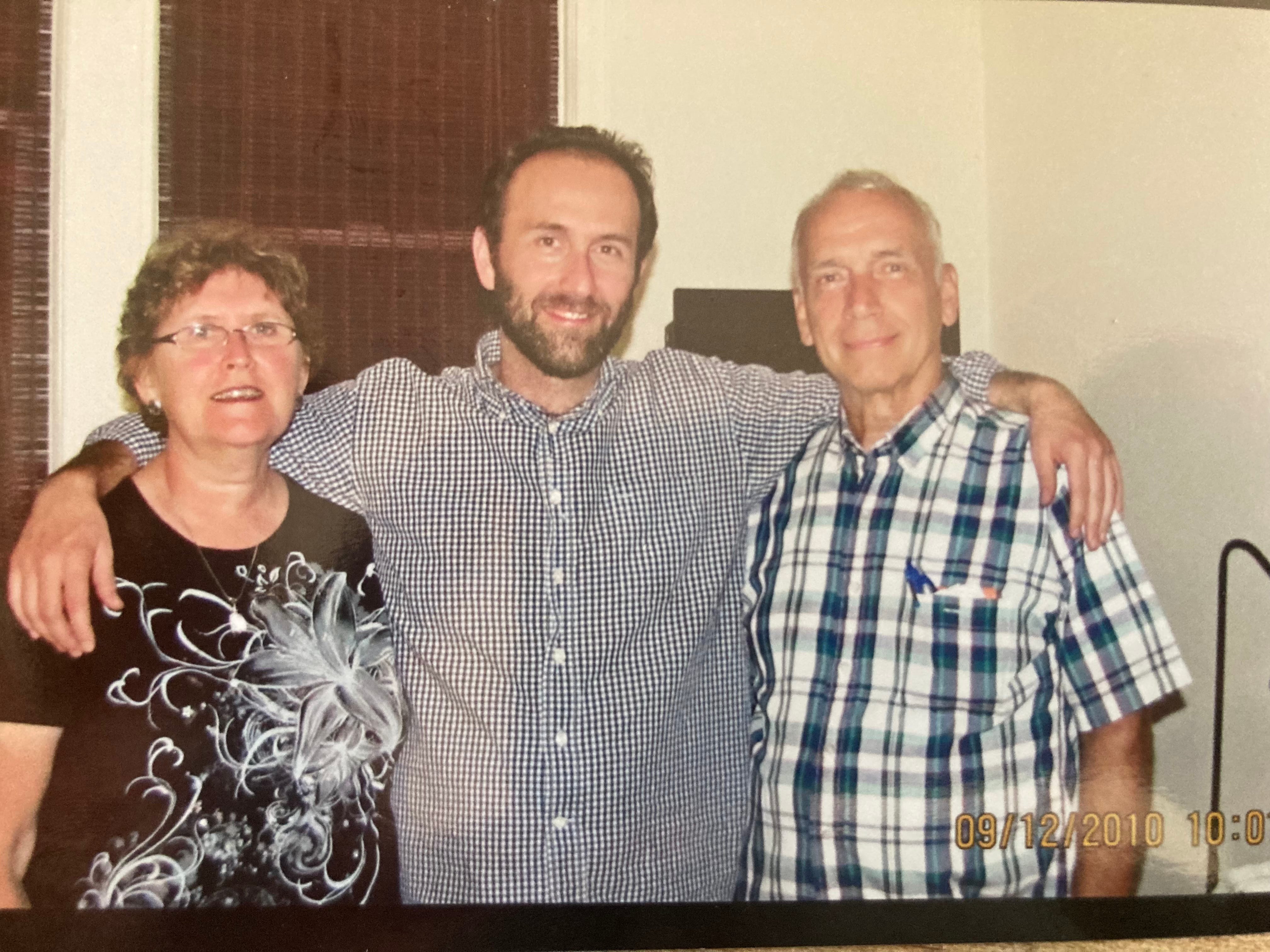
My father died on Saturday. When I was a young man eager to find my place in a world of books, he discussed with me, his literary-minded son, Vladimir Nabokov and Doris Lessing and Stephen King and Henrik Ibsen and Frank Herbert and Heinrich Heine, among others. He taught me to love Beowulf. He was a truck driver for Wegmans for thirty years, but he had varied interests—from hunting to gardening to the German language to capturing photos of birds in his yard. The old saying “you can’t judge a book by its cover” surely applies to him. Over the years he read all my published translations, essays, stories, and novel. My brothers and sister connected with him differently, of course, which is to be expected. He was an intellectually curious man who carried a notebook and pen in his pocket (see photo above), always ready to jot something down. I honor his memory by harnessing the power of my own curiosity.
But this post isn’t about him—or me. I start with him because it’s the only way I can start, given the circumstances. Last Saturday, just a couple hours after he passed away, I performed in Rochester’s edition of Listen to Your Mother. I’d originally auditioned for this show as a way to honor my mom—and I’d hoped she could take a break caring for Dad for one night and come out and watch. That was not to be, it turned out, but as I have explained to others, participating in that show was an imperative for me. As Dad knew, one of the great joys of my life is in untangling knots of language and carving meaning out of words. I don’t always succeed, but I always make an honest effort. And in this story about Mom, I tell of an impactful moment that has stayed with me forever—that has in fact shaped who I’ve become. There were more than 500 people in attendance at the Hochstein School in Rochester, NY, and it was a powerful experience for each and every one of us who read. My wife, Pia Møller, also performed a wonderful story about her mother back in Denmark. A huge thanks to RocVox for producing the video seen below.
We all have, I hope, a similar story to tell about ours moms and dads.
Her Name is Sue (text version)
We’re driving down the road—my mother, my siblings, and me—when we spot an elderly woman sprawled on her front lawn. She’s on her back, and she appears to be pretty dead. The summer air is as sticky as cotton candy. We live in a small Livingston County town and we’re driving to our friend’s house because they have something we don’t: a pool.
Seeing the woman on the ground, my mother immediately swerves the car into her driveway. My sister, who is the oldest and by far the smartest among us, surveys the scene with the wisdom of her twelve years and says, “Maybe she’s just getting a suntan.”
In the backseat my eleven-year-old-brother is angry at Mom for stopping to help. Slumping in his seat, he sulks: We hardly ever get in a real pool.
Then there’s my middle brother, the only one among us to inherit a love of farming: “She’s probably just taking a break from pulling weeds,” he says.
Me? I’m eight years old and gobsmacked. Convinced what I’m witnessing is, in fact, a very dead body. Remarkably, what I see on the ground is not the skinny old woman my siblings (and mother!) will recall decades later. You know that scene in Harry Potter and The Prisoner of Azkaban where Harry gets so mad at his Aunt Marge that he magically transforms her into a grotesque, human-shaped balloon? That’s what I see pinned to the grass.
As if the woman’s already a bloated corpse.
*
We pass our wisdom down from generation to generation. Mom grew up on a Genesee County farm that was founded by her great-great-grandfather in 1818. Like all farm kids, she had chores. She tended chickens, gathered eggs, harvested hay, and cleaned the house; she was also the big sister of three rowdy boys. When she was twelve, an exploding tractor tire nearly killed her father; the blow scissored his cheeks just under his nose, leaving bloody flaps of skin the length of his face along with a grisly, macabre grin. In his characteristically stoic fashion, Grandpa didn’t think he was badly hurt, and somehow he managed to convey this message to my grandmother.
Picture him in this moment as John Cleese playing the Black Knight in the famous scene from Monty Python and the Holy Grail. After having his arm chopped off, the Black Knight says petulantly, “It’s just a flesh wound!” Well, Grandma was much too sensible a woman to listen to her husband’s manly bullshit. Instead of waiting for an ambulance, she shoved him in the car and drove him straight to the hospital in Batavia, saving his life.
Within days, to no one’s surprise, Grandpa was back to work. It’s out of this practical, hardworking, no-nonsense, can-do environment that my mom emerged. When setbacks happen, you pick yourself up and get back to work.
And when you see someone on the ground, you bolt into action.
*
Mom parks our station wagon and hustles over to the woman while we watch from inside the hot car. After a moment, she rushes inside the woman’s house. A few minutes later, an ambulance arrives with its lights flashing. We’re finally free to swim in our friend’s pool.
I’m bursting at the seams with enthusiasm when Mom finally returns to the car. “Mom!” I shout, “You’re going to get a medal!” To my kid brain this seems like a truly awesome thing. The woman suffered a heat stroke, and my mother saved her life.
But Mom settles into the driver’s seat and shakes her head. Without even considering the awesomeness of a medal, she says: “You don’t do things to get medals, honey.”
*
Later that same summer, I sifted through our mail and discovered a letter addressed to Mrs. William Semmel. I distinctly recall puzzling over the peculiar fact that in this melding of names my mom’s entire being was subsumed within my father, invisibilizing her. She’d already lost her family name; now she’d lost her given name. This seemed particularly odd since it was my mom who cooked and cleaned and kept us kids washed and clothed while dad worked long hours as a truck driver for Wegmans. She wasn’t invisible. She was the spine holding my childhood, and our family, together.
In 1996, Dad was diagnosed with non-Hodgkins Lymphoma, likely the result of exposure to Agent Orange in Vietnam. The disease forced him into early retirement. Although he made it through, he’s been plagued by recurring ailments ever since, and wracked with debilitating bouts of depression.
Last year, Dad had a triple bypass. There were complications leading up to the surgery, and Mom sat by his side for days at the hospital. A year later, his body weakened, Dad’s back in the hospital for what appears will be the last time. Mom gathers her strength and fights through her exhaustion to be with him every single day. A loving wife, devoted to the very end.
When I gaze back at my childhood with the clarity of my adult self, I recognize that Mom’s humble indifference to public recognition is a core building block of my life. If my own son learns one thing from me, let it be what Mom taught me: kindness and humility.
She shies away from the spotlight. She didn’t get a medal for helping the woman who’d collapsed on her lawn, and she won’t get a medal for her steadfast devotion to her children and husband of nearly 60 years. But she doesn’t care. You don’t do things to get medals, after all: You do things because they’re the right things to do. When you see a person lying on the ground, for example, you’re the one who swerves your car into the driveway to help. I’ve carried this valuable lesson with me for forty plus years.
I understood long ago that Mom is far more than “just” Mrs. William Semmel, a woman concealed behind a man’s name on an envelope. If she stepped forward today, into the limelight of public attention, you’d recognize her as a woman of enormous strength and fortitude.
If you introduced yourself, she’d humbly tell you her name is Sue.
* K.E. Semmel is a writer and translator. His fiction and nonfiction have appeared in Ontario Review, Lithub, The Millions, HuffPost, Electric Literature, The Writer’s Chronicle, The Southern Review, Washington Post, and AARP online, among others. His debut novel, The Book of Losman, is about a translator in Copenhagen living with Tourette Syndrome. More at kesemmel.com.
My condolences to you and your family.
I loved your reading and appreciate this tribute to both of your parents. I'm so sorry for your loss.